
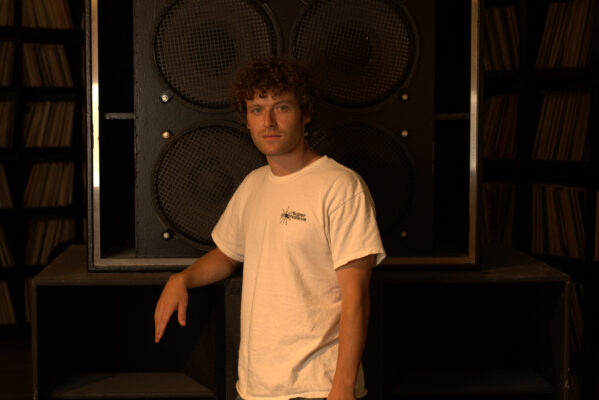
Mango Alley’s new Convergence series opens with a mix from Super Progressive, the platform created by American writer and curator William Noglows. Over the past few years, Noglows has become a key documenter of the genre, publishing long-form interviews and features that connect today’s producers to the wider history of progressive house. It makes sense that he would be asked to translate that curatorial sensibility into a mix, because his work has always been about how the pieces fit together rather than any single track.
The set takes its time to settle. Claudio Cornejo’s Alnitak brings a sense of space, Joaquin Salmain’s Biloba adds flickering energy, and Leandro Murua’s Radioactive steadies the pace with more insistence. It’s not a dramatic opening, but one that leans on careful layering, each track building the foundation for the next.
As the mix moves deeper, it grows darker and more pointed. Redspace & Al Park’s Trends is crisp and percussive, Tiefstone’s Exerion pushes harder with a metallic edge, and Jordan Gill’s Hex bends the mood inward, its melodies more hypnotic than forceful. Later, Dowden’s Gavia and Maze 28 with Rockka’s Chroma provide a late peak, sharp and direct, before the final stretch begins to release its grip. Coqueit’s Scylla holds tension in suspension, Agustin Pietrocola’s Focus regains clarity, and Unusual Soul’s In Circles starts to dissolve the structure before Elliot Moriarty’s Rosario Dreams closes on a reflective note.
What lingers most isn’t the individual highlights but the way they are strung together. The segues are handled with restraint, each shift more like a slight tilt than a hard break. This patience gives the whole arc a natural flow, closer to a narrative than a collection.
It’s worth remembering that the commercial mix format has always had an uneasy place in electronic music. The great series of the past – Balance, Global Underground, Renaissance – were celebrated for distilling a scene into a coherent journey, but they were also products to be consumed, snapshots rather than the messy reality of the dancefloor. In recent years, as streaming and algorithmic playlists have taken over, the art of the continuous mix has sometimes felt sidelined. What Convergence suggests is that there’s still value in the form: not just as promotion, but as a statement of how a genre holds together across continents, labels, and generations.
Noglow’s debut chapter shows that progressive house is still best understood in long arcs. Peaks and breakdowns matter less than the way energy shifts, how tracks lean into one another, and how connections are drawn between familiar names and newcomers. In that sense, Convergence does exactly what its title implies: it brings threads together until the pattern becomes visible.
Convergence 001 is out now