
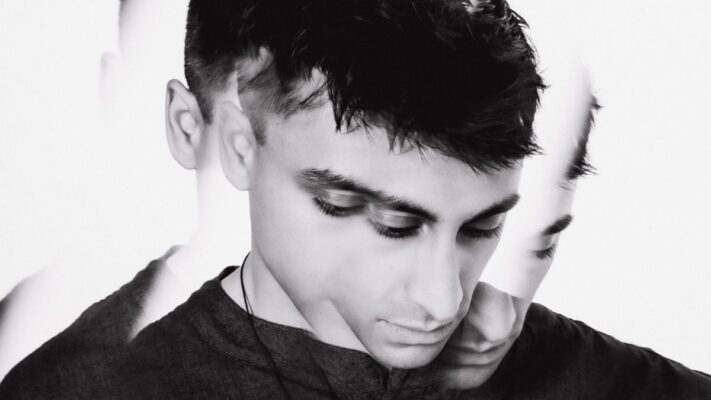
ShiShi’s journey from bedroom beatmaker to rock frontman spans two decades, three continents, and countless sonic reinventions. With Indigo, his latest LP, the SAE-certified engineer trades laptop production for live drums and power chords. While somehow making tabla players and harmoniums feel right at home next to distorted guitars. It’s a bold pivot that required stripping away the layers of electronic production he’d hidden behind for years, revealing something rawer and more honest.
In this interview, we dig into the technical evolution behind Indigo – from the minimalist approach that makes room for unpredictable live instruments to the tribal drums that remain his sonic signature. ShiShi breaks down how his BAHÉ project served as a bridge between dance and rock, why he chose vulnerability over polish, and how Eastern philosophy now matters more to him than Eastern sounds. Eight years after “Aarti” put Bollywood on the dancefloor, he’s less interested in sonic fusion and more focused on smuggling Vedic wisdom into Western rock—one 432 Hz-tuned track at a time.
Connect with ShiShi on Instagram | Spotify | Soundcloud
As an SAE-certified recording engineer, how did your technical training inform your approach to capturing both the raw energy of rock and the subtleties of Indian classical instruments like tabla and harmonium in the same sonic space?
I think I’m just fortunate because I got to learn the basics of music production and engineering, which helped me translate. Because I know the basics, I can kind of jump from one genre to the next and understand it, filling in the gaps as I go. So the basics are the same, whether you’re making electronic or rock music. It’s just about how you apply those fundamentals. In that sense, it helped me a lot knowing those fundamentals.
You’ve evolved from laptop beat-making to full rock production with Indigo. Can you walk us through your current studio setup and how your production workflow has changed from your early electronic work to handling live drums, guitars, and traditional Indian instruments?
I think the main thing is being much more minimal with the electronic elements, because I know later down the line, I’m gonna have to make room for live instruments, which tend to be more dynamic and unpredictable because they’re played by humans. For me, it was really about challenging myself to say what I need to say with each song, with the message, with as little fluff as possible.
I think with electronic production, sometimes it’s easy to overproduce because you can add so much and keep adding stuff. It can be a subtle way of hiding what you truly want to say if you’re not fully confident about it, whereas with live instruments, more of you has to go in or whoever is the player. Because I know that I’m singing on every song, pretty much, and there’s going to be guitar and live instruments, it’s a more vulnerable process, but it also feels more honest for me as well.
The transition from your ambient sound healing work on Homecoming to the emotionally textured Chrysalis to the rock intensity of Indigo represents a dramatic sonic evolution. What production techniques or sonic signatures have remained consistent throughout this journey as uniquely “ShiShi”?
What’s remained consistent—except for Homecoming, which is an ambient album—is definitely my emphasis on drums. I think my drums are always pretty identifiable. I have a lot of global-style drums and influences that I use, and I always try to make it really tribal and global-sounding.
You can hear that on a record like “When It’s My Time” or on “KALI” or on the Chrysalis Theme as well. There’s always going to be some nod to Indian music. There’s always a little bit of musical tribute to Indian instruments, especially spiritual Indian instruments.
I’ve pretty much used a bansuri (Indian bamboo flute) since I started, and that’s still something I love using in my music, although it’s changed. Ultimately, I always choose chords that tend to be pretty simple and catchy and accessible. I try to get fancy with my lyrics and musical choices more than with the actual musicality. So I think that’s a signature of ShiShi.
With your BAHÉ project exploring “spiritual dance music” and your solo work now embracing rock, how do you compartmentalise these different sonic identities in the studio? Do they inform each other during the creative process?
I actually think BAHÉ was a very necessary stepping stone to this album because I was already exploring a lot of rock elements on BAHÉ. If you listen to a song like “Secret Garden” by BAHÉ, you can hear it’s a dance record, but it’s also very rock, with solos and a lot of guitar. I was already writing lyrics for BAHÉ and experimenting with singing a little bit as well.
BAHÉ was, in many ways, a transitional album, somewhere between dance and rock that really helped me get to Indigo.
You’ve mentioned that Indigo features “fluid production” for the live show. How are you approaching the technical challenge of creating dynamic, transformative soundscapes in real-time while maintaining the album’s studio precision?
Fluid production means creating dynamic, transformative soundscapes in real time while keeping the album’s studio precision. I don’t really have too much desire for it other than keeping the structure of the arrangement and the lyrics the same. Anywhere there were drums or guitar on the original records, I was open to not needing to maintain exactly how it sounded, because I’m working with such talented instrumentalists on drums and guitar. I wanted them to shine, to bring new life. And I feel like we did that. My vocals are live, and all the other electronic stuff was keeping that, but some of it we let go of. In general, I was more skewed towards creating new versions of these songs rather than sticking to the older versions. It feels like making remixes of the songs.
You have worked with artists from Daramola to Rickey Kej across vastly different genres. What production lessens from these collaborations shaped your approach to self-producing Indigo?
With Daramola, our collaboration was always about him being the singer and me being the producer. I learned vocal techniques from him, like how to sing into a microphone and how to cut takes efficiently. It was a big process of developing inner confidence and believing I can sing. Ricky Kej is an amazing producer who brings together really talented artists who work well together. I learned from him about putting together the band. He also merges East and West in really cool ways. That’s been inspiring to me too.
Your 2017 breakout “Aarti” reimagined Bollywood through electronic production, accumulating 6 million streams. Eight years later, how has your understanding of marrying Eastern and Western musical languages evolved technically and philosophically as a producer?
Back then, it was rudimentary. It was like… this is a Bollywood song and I want to put it on a dance record. At the time, that was somewhat novel or innovative. Now, there’s Indo Warehouse and many others doing that which is cool. But for me, it’s evolved into wanting to bring Eastern wisdom into Western music. It matters less sonically that it sounds really Indian, and more that the Vedic philosophy from India is communicated. That’s something I didn’t have the context or knowledge of back then.