
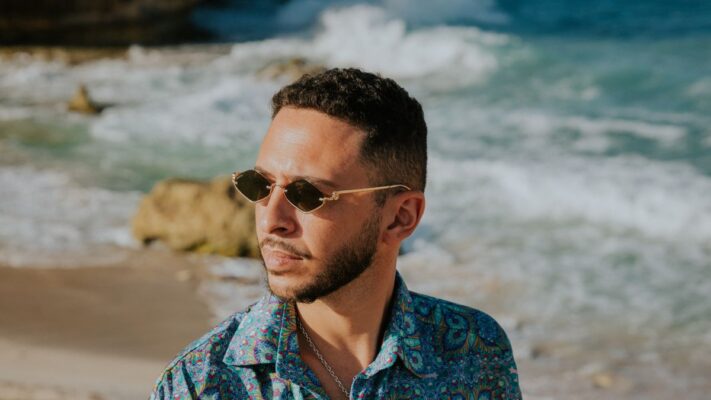
Long before clubs, dancefloors, or algorithms played any role, his relationship with house music began in solitude. In his bedroom, surrounded by cassette tapes passed on by older friends returning from clubs he hadn’t yet experienced himself, he absorbed more than just tracks. He heard DJ voices, raw energy, and a sense of freedom he couldn’t yet define, but instantly felt. It was there—far from any dancefloor—that the idea of becoming “the person behind the music” first took shape.
That instinctive, uncompromising approach still defines his path today. Entirely self-taught and resistant to trends, his journey unfolded quietly, driven by years of focused work rather than visibility. Together with Manda Moor, he later founded Mood Child—a platform rooted in emotion over strategy, where moods replace genres and house music is treated not as a product, but as a living, shared culture.
Connect with Sirus Hood on Instagram / Soundcloud
You discovered house music at a very young age through mixtapes. Can you share one of your earliest memories and how it shaped your journey?
I discovered house music through mixtapes that were given to me by older friends who were already going out to clubs.
I discovered house music through mixtapes that were given to me by older friends who were already going out to clubs. They would come back with tapes recorded directly from DJ sets. At that time, I didn’t even know what a dancefloor was. I was just listening to the music at home, hearing the DJ speak or sometimes sing in English over the tracks, without fully understanding the words. I remember thinking that I wanted to be that person behind the music. Those tapes shaped my imagination and planted the idea of becoming a DJ long before I ever experienced a club for myself.
Which artists from the Chicago house scene or beyond influenced you the most, and what lessons have you carried forward into your own productions?
Chicago artists taught me something essential: to be real and to be yourself without filters.
Chicago artists taught me something essential: to be real and to be yourself without filters. DJs like DJ Deeon, Paul Johnson, DJ Sneak, or DJ Pierre showed that honesty matters more than perfection. Their music was direct, sometimes raw, but always sincere. That mindset stayed with me. I try to keep that same honesty in my productions instead of chasing trends or expectations.
Being entirely self-taught as a DJ and producer is pretty rare. What were some challenges you faced learning your craft without formal training?
The biggest challenge was doubt. Without any formal validation, you constantly question whether you are doing things the “right” way. Over time, I realised there isn’t a single right way. Being self-taught forced me to develop my own language and trust my instincts, which eventually became a strength.
You originally refused to use social media when you started your project. How do you feel about social platforms now?
At first, I wanted the music to exist on its own. Over time, I understood that social platforms are simply tools. I still approach them carefully and selectively. For me, they are useful to share context or ideas, but they should never define the music itself.
Looking back, what would you say was the real turning point in your career?
There was a long period where nothing visible was happening. I was producing every day for years, alone, focused on refining my sound without knowing where it would lead.
The real turning point came in 2014, during my first performance in Brazil. I was playing in front of thousands of people, and I realised they already knew my tracks and were reacting to them. That moment made me understand that the work done in isolation had travelled far beyond what I imagined.
What was the original idea behind Mood Child when you and Manda Moor started it — and how has that vision evolved?
Mood Child started from a simple idea: sharing music driven by feeling rather than strategy. Over time, the vision became clearer. I’ve seen two types of labels. Some begin with a strong vision, then slowly adapt it to what seems successful, often losing quality along the way. Others stay focused on what they truly want to share, regardless of trends. Mood Child belongs to that second approach. The strategy hasn’t changed, but the level of quality has continuously grown.
The Mood Edits series has become a cult favourite. Could you tell us how the concept originated?
We created Mood Edits with Manda during the COVID period. Many labels had stopped releasing music, and we had nowhere to put our tracks. Edits felt natural because that’s how house music was created, by reworking disco records. We released music meant to be listened to at home, with friends, in the car, or during the few rare parties happening around the world. DJs like Jamie Jones, The Martinez Brothers, or Loco Dice started playing those edits, and they spread very quickly. The fact that they were available only for a few weeks before being removed created an unexpected energy. The response went far beyond what we imagined and directly inspired the creation of Mood Child.
Mood Child feels like more than just a label. How do you balance creative freedom with maintaining a strong collective identity?
Mood Child isn’t built around a single genre. It’s built around moods. We curate different moods depending on what we feel at a certain time of the year and what we want to share. That approach allows creative freedom without diluting identity. In fact, it strengthens it. The consistency comes from intention and curation, not from stylistic rules.
Who are some artists you’ve worked with on Mood Child projects that have surprised or inspired you, and why?
Some artists stand out through their quality and consistency, like Malikk, Reboot, or Marian (BR), who each released their own Mood Album. DJ Sneak was also very inspiring. He released his first-ever sample pack on Mood Child, which is quite remarkable considering how influential he has been for generations of producers, including artists like Daft Punk. That release inspired hundreds of other artists. In other cases, artists directly inspired entire moods, such as the Cartel Moods series, influenced by YSNXS – Bellaqueo.
How would you describe the “Mood Child sound” to someone who’s never heard the label before?
I don’t really think there is a Mood Child sound in terms of style, even though some people like to analyse it that way. I’m not sure how they do it, but if it works for them, that’s fine. What definitely exists is a connection between all the tracks. Styles can vary a lot, which is why we express them through moods. On a more technical level, I master all the releases myself. My mastering has a very specific character that many people recognise: analog, warm, smooth, powerful, and non-aggressive, close to what you feel on vinyl. I take a lot of time with this process, and so far, I haven’t found anyone who could replace me for that work.
Your sound blends classic Chicago house with modern influences. How do you preserve that raw, analog feel while staying forward-thinking?
I use my original Roland machines like the 808, 909, and 303, which have their unique sound. I also work with other hardware and play my own drums, often using Maschine or MPC Live. That physical interaction with sound helps keep things raw and personal.
Can you share any upcoming releases, collaborations, or special projects you’re excited about in 2026?
I’m currently working on a documentary about the birth of house music, along with a Chicago house album connected to that project. Projects like this involve many people, often based in the United States, and require a lot of travel, meetings, and time. I prefer to speak about them properly when the moment is right.
I’m also working on something new with Manda. I’ll share more soon.
I’m very excited about the Mood Child shows we’re currently putting together, especially in cities like Chicago, Miami, and New York, as well as in Thailand. We’ve also just announced a show in Barcelona on February 1st at KU.
Looking ahead, what legacy do you hope Mood Child and your own music will leave on house culture in the next decade?
I hope Mood Child and my music help preserve the emotional core of house music while allowing it to evolve. Beyond the music itself, if the documentary can help document and transmit this culture to future generations, that would be a meaningful legacy for me.
Thank you